

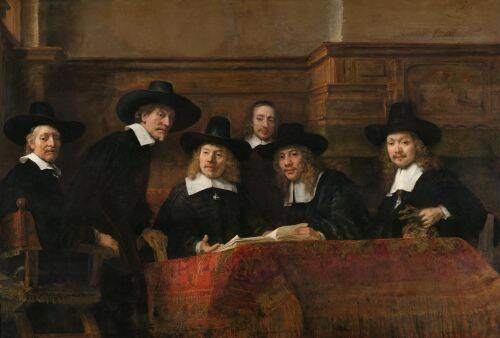
members of the Silk Drapers guild by Rembrandt 1662
Guild: Etymology and Meaning
The word "guild" likely derives from the Anglo-Saxon root "geld," which means "to pay" or "contribute." This reflects the idea of members contributing resources for common purposes, including protection and trade. Some interpretations also suggest a connection to religious practices, indicating a deeper cultural significance. A guilder was a coin.
When Dayna and I sat down in the cafeteria of The New School in early 2024 we were trying to figure out the best way to create representation for Figure Models. Dayna began to research and conduct outreach to various labor unions and legal aid organisations to see whether figure models could be recognized and welcomed as labor force...or not. To find out what our options were she reached out to VLA (Volunteer Lawyers for the Arts). After a long wait their response was they couldn't help us because they did not deal with Labor Law. Next she reached out to the UAW, an outgrowth of the AFL originally known as the United Auto Workers Union established in 1935 that had since morphed into SENS - UAW in 2016 allowing student teachers into their fold. Influenced by the National Labor Relations Board (NLRB) student teachers were permitted to unionize at private institutions. In New York City that private institution was The New School which had merged with the Parsons School of Design. This move opened the door to workers at The Mann School of Music, the graduate student teaching assistants, resident dorm workers for on campus housing and others to join that union, protest, strike and negotiate better contracts. Dayna even joined a picket line one day. At first because figure models official standing with The New School was as employees or W2 workers we thought that this might be an opening for us as a collective but soon discovered that Figure Models were deemed to small of a labor force by union reps. But what does too small mean when you are struggling to pay your bills? There were two things that mystified them. The first was wanting to know the actual number of models working in the fine arts and fashion departments. This obscurity stemmed from the lack of transparency hidden behind school policy. Figure Models are not privy to that information like other workers inside the school which kept models isolated from each other.There was no common area for models to convene in the way teachers have in a teachers lounge. Second, the reps wondered why more than a dozen models couldn't show up for a tete a tete? The answer lays in the strictures of our schedules. These practical realities of our daily lives are not understood. For us this was another symptom of established channels within the labor movement lacking a clear vision of the physical nature of our job while dismissing the value of our labour. Classes cannot run without us. Instructors rely on models to demonstrate what they are teaching. The importance of our labour which literally holds up the creative process in the Art Industry in New York City has been deliberately ignored. We found this exceedingly ironic. What the union reps, as well intentioned as they were. didn't grasp is that figure models cannot show up in large numbers to a meeting during conventional hours because our work hours do not follow convention. It is the norm to work shifts that begin at 5 or 6 or 7PM for the night classes and sessions art institutions hold for their alumni. In reality, figure models work multiple shifts in a day from eight in the morning until ten o'clock a night, six or seven days a week in multiple job sites precisely because the wages paid keep figure models living below the poverty line. It is sheer survival. Once you factor in school holidays and unpaid cancellations for bookings you begin to understand the hostile terrain of a workplace landscape that is already exploitative. 1099 workers cannot claim unemployment benefits either. We then we reached out to NYLA. NYLA is a platform for dancers and performing artists, focusing on unionization and advocacy. Since the days of Marie Van Goethem, dancers have been working as Figure Models to make ends meet. (For those whose full time passion is dance NYLA is an organization that could prove supportive). The NYLA rep pointed us in the direction of EWOC (Emergency Workers Organizing Committee) which offers grassroots organizers training on how to unionize, organize and advocate for improved working conditions and wages in their workplaces. Dayna audited the course and I got my certification April 2025. But after all that research, we realized figure models were still on their own. In other words Figure Models were going to have to do the work to fend for themselves as a collective. At least we understood ourselves. And as in ages past a Guild is a way to accomplish our goals. According the Cambridge dictionary a guildis an organization of people who do the same job or have the same interests.
Functions of Guilds: Regulation of Trade: Guilds set standards for production and trade practices, ensuring quality and fair competition among members.
Political Influence: By acting collectively, guilds gained political power, influencing local governance and economic policies.
According to Wikipedia A guild (/ɡɪld/, GHILD) is a professional association of artisans and merchants who oversee the practice of their craft/trade in a particular territory...There might be controls on minimum or maximum prices, hours of trading, numbers of apprentices, and many other things. Critics (*worthy to say businesses by private entrepreneurs) argued that these rules reduced free competition, but defenders maintained that they protected professional standards.[1]
Origins and History of guilds: Guilds have appeared in many timelines in human history revolving around labor and goods for the protection of those workers in a particular field. Ancient Rome had guilds, the Akkadian Empire had guilds stretching back to the mid 2000 B.C.E.s. What rings a bell for us are the Medieval and Renaissance Guilds which flourished between the 10th and 16th centuries in the Netherlands, Germany, Italy. Guild Halls served as meeting places for celebrations, feasts and even to dispute settlements. Most intriguing is the role a guild can play in protecting economic interests of the members.
Add comment
Comments